


The Online Score That Confused My Grade 8 Student (And How to Fix Bad Notation)

Updated: Jul 26
One of my private piano students recently decided to learn a fun, lighthearted piece alongside his Grade 8 repertoire.
Key Takeaway:
Rhythmic grouping in music notation exists to show the beat unit clearly to the performer. Incorrect beaming or grouping—such as beaming across the middle of a 4/4 bar or obscuring dotted crotchet pulses in compound time—confuses sight-readers and leads to lost marks in higher-grade theory exams like ABRSM Grades 6–8.
He found the sheet music online himself and started working on it at home. But during our next lesson, he paused, looked at me with genuine concern, and said:
"I got completely stuck in this section... I just couldn't figure out how to count these demisemiquavers."
Demisemiquavers?! In a simple piece like this?
I took a look at the score he was reading, and my heart sank:
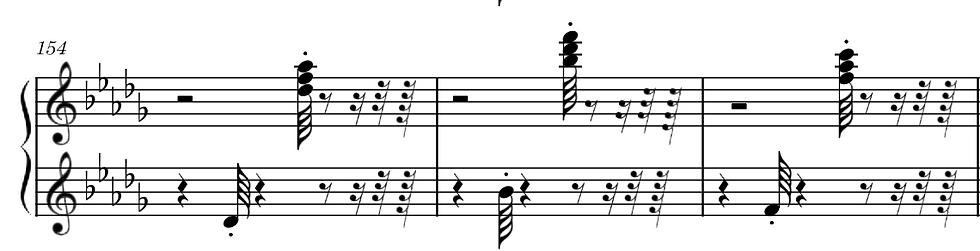
My immediate thought was: OMG, where do I even start with this?
Would you know where to start?
It All Comes Down to Grouping
In 6/8 time, the fundamental rule of engraving is that the bar splits cleanly into two dotted-crotchet pulses (1-2-3, 4-5-6). You must be able to visually see Beat 4 so your brain knows where the mid-point of the measure lives.
Look at that excerpt again:
Where are the main dotted-crotchet pulses?
Why are there so many random rests scattered across the beats for no reason?
Why are duration values tied in ways that completely obscure the meter?
My student wasn't struggling with his rhythm skills—he was struggling to decode a chaotic layout that forced him to stop and do math just to find the beat!
The Clean Fix
Here is how that exact same passage looks when re-engraved following standard notation rules:

Notice the difference:
Clear 6/8 Pulse: By grouping notes and rests into clean quaver units, the mid-bar boundary (beat 4) is instantly visible.
No Unnecessary Rests: Rests are consolidated so the eye isn't tripping over fragmented silences.
Readable Voice Leading: Stems and ties now guide the hands naturally instead of clashing across the staff.
When notation is clean, your brain doesn't waste energy decoding what the notes are—it can focus entirely on how to play them.
📥 Free Download: Master Grouping & Time Signatures
Want to make sure your own scores (or your students' sight-reading) never get tripped up by confusing notation like this?
Download our free Time Signatures & Rhythmic Grouping Reference Guide. It breaks down the core rules of beams, rests, and meter divisions so you can spot notation errors in seconds.
📖 Take Your Rhythm & Music Theory Further
If you teach, write, or prepare for higher-grade theory exams (like ABRSM Grade 6–8), understanding rhythmic structure is the single biggest key to fluent reading and score analysis.
Looking for a comprehensive rhythm guide? Check out our handbook, Rhythm, which covers every time signature, beam division, and complex grouping rule in detail.
Preparing for higher grades? Explore the full Beyond Grade 5 Series for advanced theory resources designed to make complex concepts simple.
Never miss a lesson: Join the TheoryVirtuoso Newsletter to get weekly music theory breakdowns, free downloads, and teaching tips delivered straight to your inbox.


Comments